
Taper Fade for Curly Hair: 25 Best Styles, Cuts & Tips
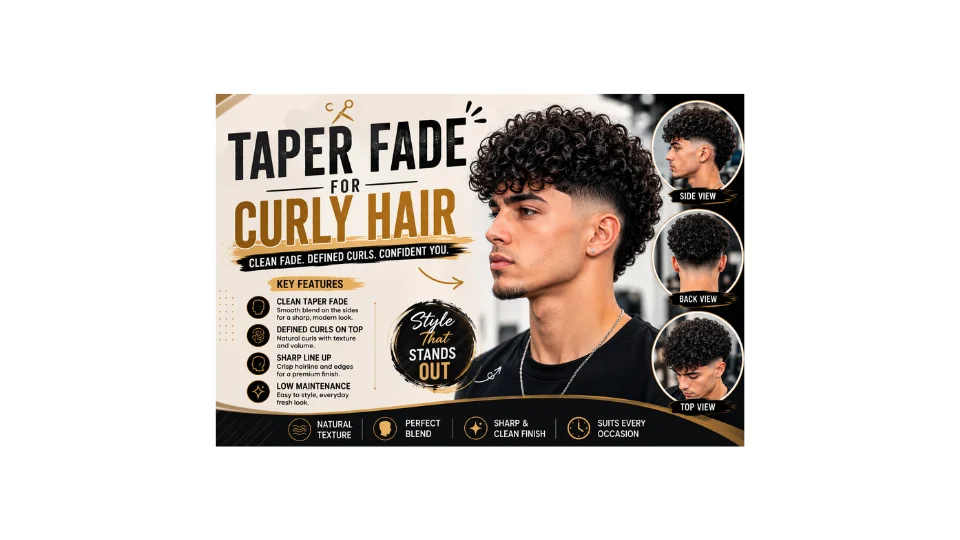
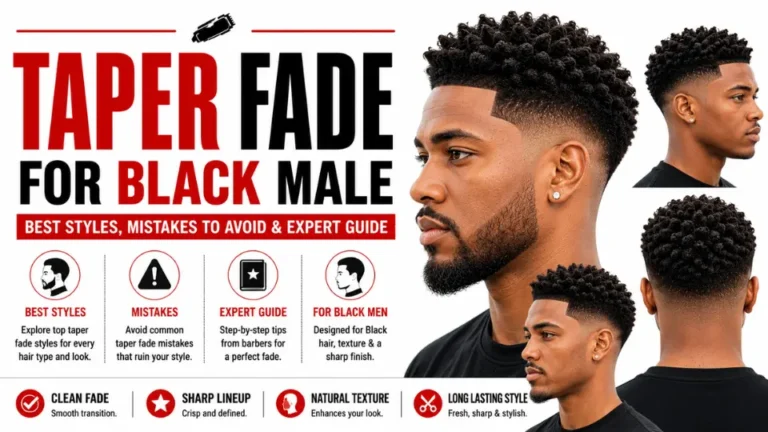
A taper fade for curly hair combines clean, gradually shortened sides with the natural volume and texture of curls on top. It is a versatile haircut that can be customized as a low, mid, or high taper depending on your curl pattern, face shape, and preferred level of contrast.
Whether you have loose waves, defined curls, tight coils, or coily 4C hair, the right taper can make your natural texture look more structured while keeping the sides and neckline neat. You can also pair a curly taper with a fringe, afro, mullet, line up, or longer hair on top.
In this guide, you’ll find 25 of the best taper fade styles for curly hair, along with tips for choosing the right taper, explaining your desired cut to your barber, maintaining your curls, and keeping the fade looking sharp between appointments.
What Is a Taper Fade for Curly Hair?
A taper fade for curly hair is a haircut that gradually shortens the hair around the sides, temples, and neckline while leaving more length and natural texture on top. Instead of removing the bulk of the curls, the taper creates a clean transition that frames the face and allows your natural curl pattern to remain the main feature of the haircut.
The taper can be customized as a low, mid, or high taper. A low taper keeps more hair around the sides for a subtle finish, a mid taper creates a balanced amount of contrast, and a high taper removes more hair higher up the sides for a sharper, more noticeable look.
Taper vs. Fade for Curly Hair
Although the terms are often used together, a taper and a fade are not exactly the same. A taper usually focuses on gradually shortening the hair around the temples and neckline while keeping more length on the sides. A fade generally extends the gradual shortening farther up the sides and back, creating a stronger transition from longer hair to very short or skin-level hair.
For curly hair, a taper is a good choice if you want to preserve more natural volume around the sides while keeping the haircut neat. A fuller fade is better if you prefer stronger contrast and a tighter silhouette.
The best option depends on your curl pattern, the amount of length you want to keep, your face shape, and how bold you want the finished haircut to look.
Why Curly Hair and Taper Fades Work So Well Together
Curly hair and taper fades work well together because the natural texture on top creates contrast with the clean, gradually shortened sides. Instead of trying to flatten or hide your curls, a taper lets them remain the main feature while giving the haircut a more defined shape.
A taper can also help control bulk around the temples and neckline. This is especially useful for thick, curly, or coily hair, where extra volume around the sides can make the haircut look wider than intended. Keeping these areas cleaner creates a more balanced outline around the face.
Another advantage is versatility. You can keep the curls short and defined for an easy-to-maintain style, or leave more length on top for a curly fringe, afro, mullet, or textured look. The same taper can therefore work with many different curl patterns and personal styles.
The key is choosing the right taper height and keeping enough length on top for your natural curl pattern to show. A low taper gives a subtle finish, a mid taper offers balanced contrast, and a high taper creates a more noticeable difference between the sides and the curls on top.
Best Types of Taper Fade for Curly Hair
The best taper fade for curly hair depends on how much contrast you want and how much natural volume you want to keep around the sides. The three main options are low, mid, and high taper fades. Each creates a different shape while allowing the curls on top to remain the focus.
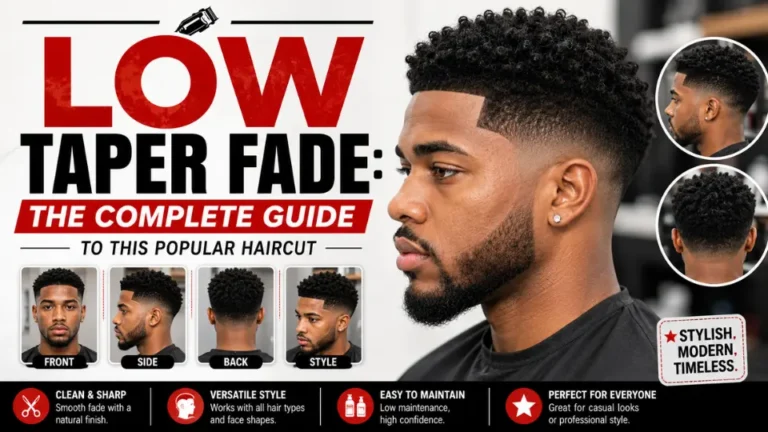
Low Taper Fade For Curly Hair
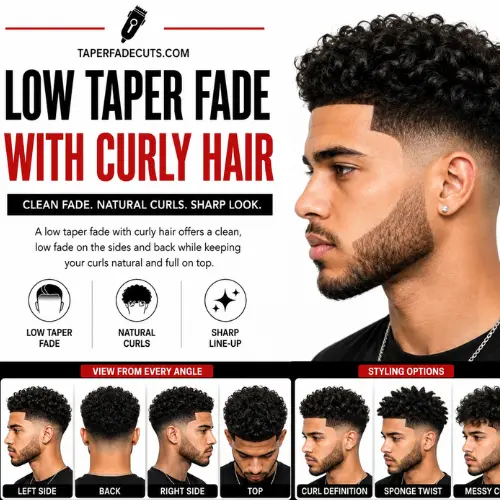
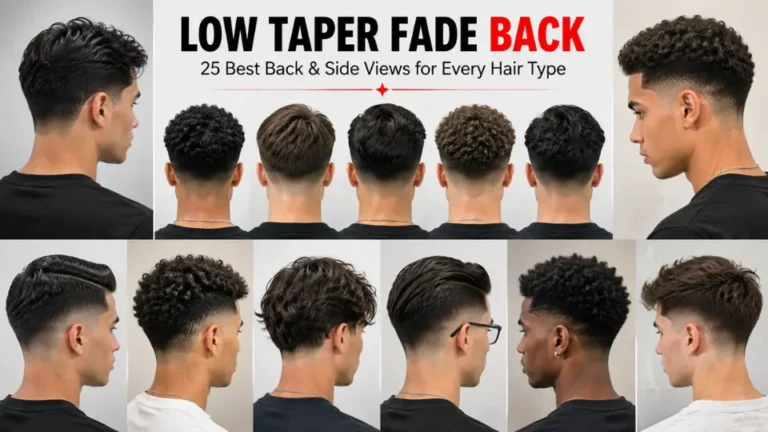
A low taper fade starts close to the ears and neckline, gradually shortening only a small area around the lower sides of the head. Because it leaves more of the natural hair intact, it creates a subtle and clean finish without taking too much attention away from the curls.
A low taper is a good choice if you want a professional, natural-looking haircut or if you are trying a taper for the first time. It works particularly well with loose curls, waves, and medium-length curly hair.
Styling Tip: Use a lightweight curl cream or leave-in conditioner on damp hair to define the curls without weighing them down. Keep the taper clean with a touch-up every 2–3 weeks.
Mid Taper Fade For Curly Hair
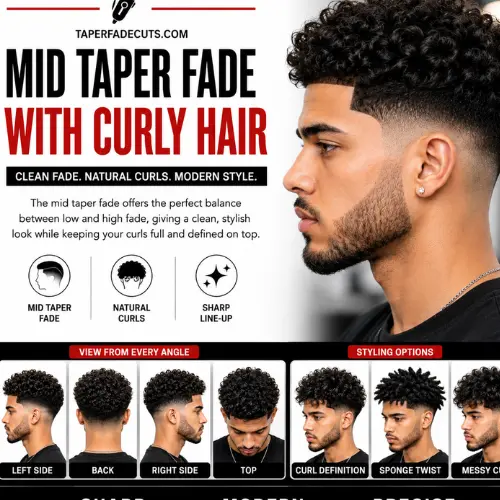
A mid taper fade creates a balanced transition around the temples and sides. It removes more bulk than a low taper while still leaving enough natural hair to maintain a fuller appearance.
For many men with curly hair, the mid taper is the most versatile option. It works with loose curls, defined curls, and tighter textures and can be combined with a fringe, textured top, line up, or longer curls.
Styling Tip: Apply curl cream or a lightweight defining product to damp hair, then let the curls air-dry or use a diffuser on low heat. Keep the sides and neckline fresh with regular barber visits.
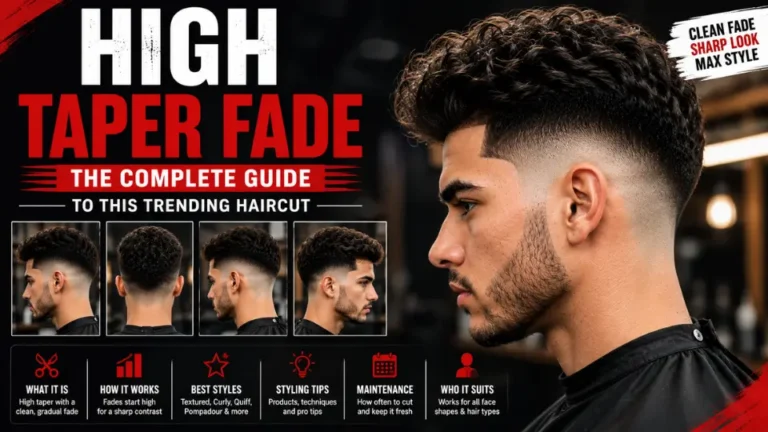
High Taper Fade For Curly Hair
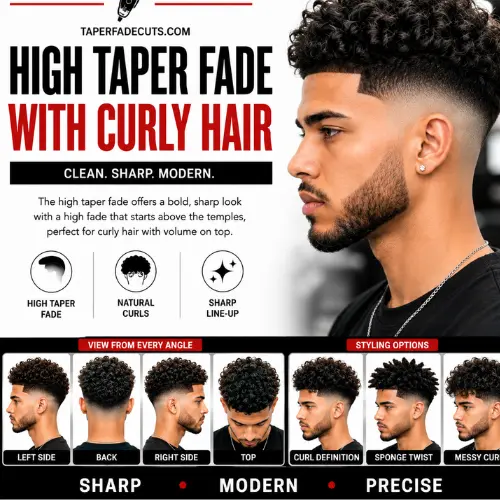
A high taper creates a stronger contrast by taking the taper higher around the temples and sides. This puts more visual emphasis on the curls left on top and creates a sharper overall silhouette.
A high taper can work especially well with dense curls, coils, and afro-textured hair because the shorter sides help define the shape of the fuller top. It can also be paired with a line up or beard for a more structured finish.
Styling Tip: Keep enough length on top for your natural curl or coil pattern to remain visible. Use a moisturizing curl product and avoid excessive brushing, which can disturb curl definition.
Other Fade Variations for Curly Hair
Low, mid, and high tapers are the main taper options, but curly hair also works well with other fade variations. These styles create a stronger or more distinctive shape while keeping the natural curls on top.
Drop Fade for Curly Hair
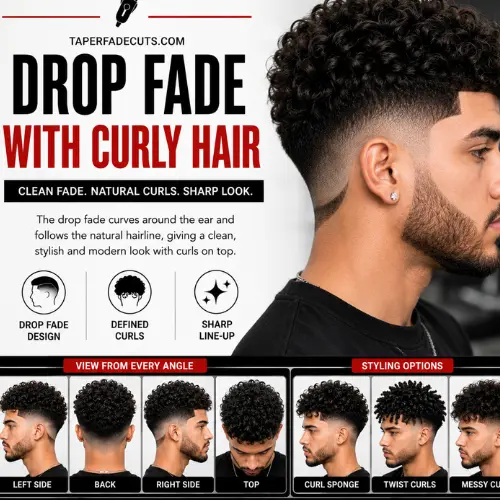
A drop fade curves downward behind the ears and follows the natural shape of the head. With curly hair, this curved transition can create a clean outline while leaving plenty of texture and volume on top.
A drop fade is a good option if you want more definition around the sides and back without removing too much length from the top. It can be paired with short curls, longer curls, a curly fringe, or a textured top.
Styling Tip: Apply a small amount of curl cream or leave-in conditioner to damp hair and allow the curls to dry naturally or with a diffuser. Keep the curved fade line clean with regular touch-ups.
Burst Fade with Curly Hair
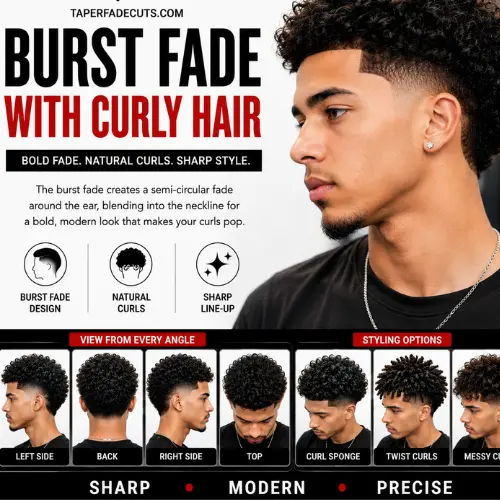
A burst fade concentrates the fade around the ears and creates a rounded, semicircular shape on each side. The top and back can be left longer, making it a strong match for curly hair and textured styles.
A burst fade works particularly well with curly mullets, curly mohawks, and longer textured tops. The contrast between the short area around the ears and the fuller curls creates a more distinctive haircut.
Styling Tip: Keep the curls moisturized and defined while maintaining the area around the ears regularly so the burst shape remains visible.
25 Best Taper Fade for Curly Hair Styles
The right style on top can completely change the look of a curly taper fade. From natural curls and curly fringes to afro shapes and textured styles, these variations let you choose a look that matches your curl pattern, face shape, and personal style.
Curly Afro Taper Fade
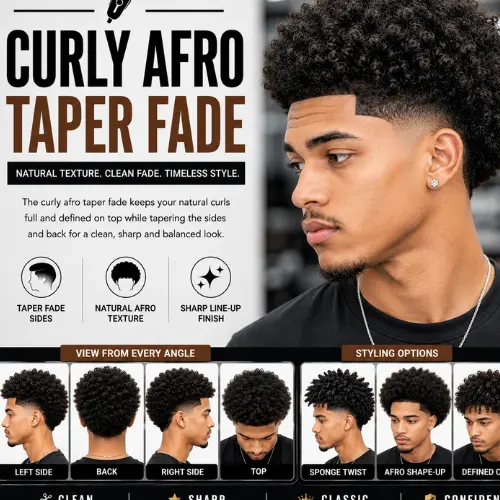
A curly afro taper fade keeps the natural fullness and rounded shape of curly or coily hair on top while gradually shortening the hair around the temples and neckline. The result is a clean outline without taking away the volume that makes the afro distinctive.
This style works especially well for dense curls and coily textures. Keep the top shaped naturally and ask your barber to create a smooth taper around the edges rather than removing too much bulk.
Best for: Dense curls, coily hair, and fuller hairstyles.
Styling Tip:
Keep your curly afro taper fade well-moisturized with a leave-in conditioner or curl cream to maintain volume and definition. Shape the afro every 3–4 weeks and refresh the taper regularly for a clean, balanced look.
Curly Fringe Taper Fade
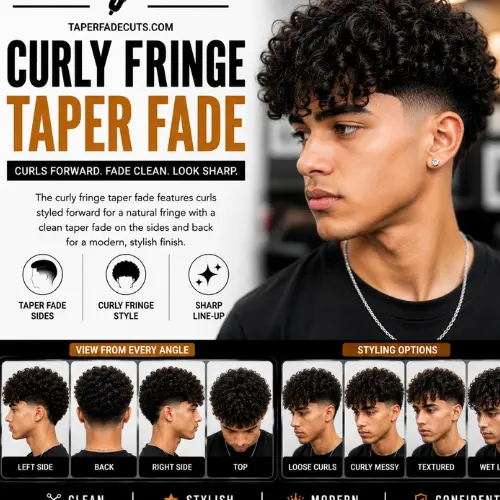
A curly fringe taper fade leaves enough length at the front for the curls to fall naturally toward the forehead while the sides and neckline are kept clean with a taper. It creates a relaxed, textured appearance without losing the structure of the haircut.
The length of the fringe can be adjusted depending on your curl pattern and how much coverage you want across the forehead.
Best for: Loose to defined curls and medium-length hair.
Defined Curls Taper Fade
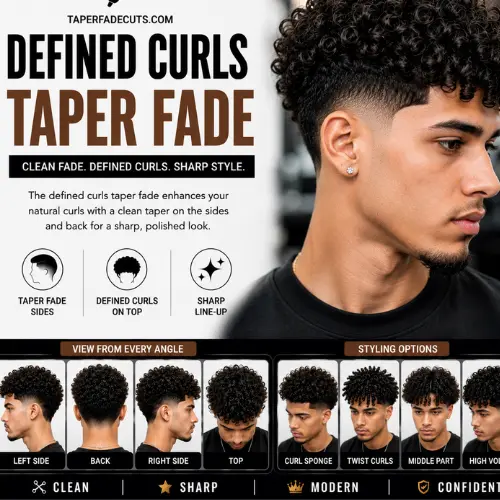
A defined curls taper fade emphasizes individual curls on top while keeping the sides and neckline neat. Curl cream, gel, or another suitable styling product can help separate the curls and enhance their natural shape.
The key is to leave enough length on top for your curl pattern to form properly. The clean taper then creates contrast without competing with the texture.
Best for: Defined 3A–3C curls and medium-length curly hair.
Messy Curls Taper Fade
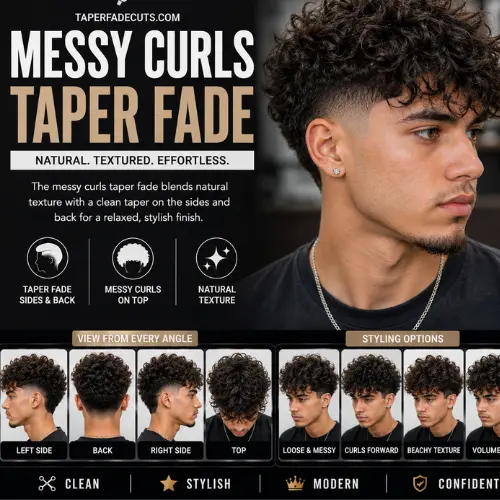
A messy curly taper fade combines naturally tousled curls with clean, gradually shortened sides. Instead of making every curl perfectly defined, the top is allowed to keep its natural movement and texture.
This is a good option if you prefer a casual hairstyle that does not require extensive daily styling. A small amount of lightweight curl cream can control frizz while keeping the top relaxed.
Best for: Natural-looking curls, medium-length hair, and low-effort styling.
Styling Tip: To keep this effortless look, let your curls air-dry or use a diffuser on low heat. Apply a small amount of lightweight curl cream or leave-in conditioner to reduce frizz while maintaining natural movement. Avoid over-styling—just fluff your curls with your fingers for a relaxed, textured finish that pairs perfectly with the clean fade.
Curly Hair with Temp Fade
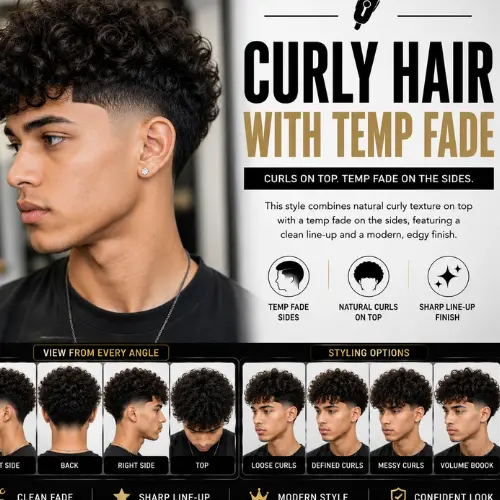
A temp fade, or temple fade, focuses the shortest part of the fade around the temples while leaving more hair around the rest of the sides. With curly hair on top, this creates a subtle frame around the forehead and temples without dramatically changing the overall shape.
A temp fade can be paired with short curls, a curly fringe, an afro, or a longer textured top. Ask your barber to preserve enough length around the sides if you want a fuller appearance.
Best for: Curly hairstyles where you want clean temple definition without a dramatic fade.
Short Curly Taper Fade
A short curly taper fade keeps the curls relatively close to the head while gradually shortening the hair around the sides and neckline. It is a clean, practical option when you want natural curl texture without maintaining a long top.
Because shorter curls can lose some definition, ask your barber to leave enough length for your natural curl pattern to remain visible.
Best for: Short curls, busy lifestyles, and easy daily styling.
Curly Taper Fade with Line Up
A line up adds a sharp, defined edge around the forehead and temples to a curly taper fade. The clean lines create contrast with the softer texture of the curls, giving the haircut a more structured appearance.
This style works best when your natural hairline is suitable for a defined edge. Ask your barber to follow your natural hairline rather than creating an overly artificial shape.
Best for: Defined curls, coily hair, and sharper-looking styles.
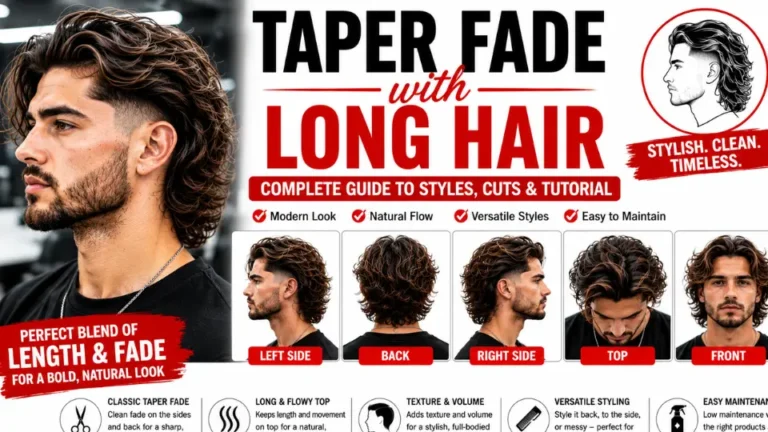
Curly Taper Fade with Long Hair on Top
A curly taper fade with long hair on top keeps significant length in the curls while gradually shortening the sides and neckline. This creates strong contrast and gives you plenty of styling options.
Longer curls can be worn naturally, pushed forward, shaped into a fringe, or styled with additional volume. Your barber should account for curl shrinkage when deciding how much length to remove.
Best for: Medium-to-long curls and people who want maximum volume on top.
Curly Taper Fade Mullet
A curly taper fade mullet combines cleanly tapered sides with longer curly hair toward the back. The curls give the classic mullet shape additional texture and movement while the taper keeps the sides controlled.
You can keep the transition subtle for a wearable look or make the contrast more noticeable for a bolder hairstyle.
Best for: Medium-to-long curls and trend-focused hairstyles.
Curly Taper Fade with Beard
A curly taper fade with a beard connects the haircut and facial hair through a clean transition around the temples and sideburns. The curly top provides texture, while the taper and beard create a more defined frame around the face.
The beard does not need to be extremely short. A skilled barber can adjust the taper and sideburn area to create a smooth transition between the haircut and facial hair.
Best for: Men with facial hair who want a balanced, structured appearance.
2C Wavy Taper Fade
A 2C wavy taper fade works with the natural movement of thick, defined waves while keeping the temples and neckline clean. Leaving enough length on top allows the waves to maintain their shape instead of appearing flat.
A low or mid taper usually works well because it preserves more of the natural texture around the sides.
Best for: Thick waves and hair that sits between wavy and curly.
3A Curly Taper Fade
A 3A curly taper fade highlights loose, well-defined curls while creating a clean transition around the sides and neckline. Because 3A curls form larger loops, keeping moderate length on top can help maintain their natural shape.
A mid taper is a versatile option, while a low taper gives the style a softer appearance.
Best for: Loose, springy curls and medium-length hair.
3B Curly Taper Fade
A 3B curly taper fade works particularly well when the curls have enough density to create noticeable volume on top. The taper removes some of the bulk around the sides while keeping the defined curls as the focal point.
Avoid taking too much length from the top if you want the curls to remain full and well-defined.
Best for: Medium-to-tight curls with natural volume.
3C Curly Taper Fade
A 3C curly taper fade combines tightly defined curls with gradually shortened sides. Because 3C curls tend to have significant shrinkage and density, your barber should consider how the hair looks both at rest and when stretched.
A mid or high taper can create a strong outline while leaving enough curl volume on top.
Best for: Dense, tightly defined curls and fuller hairstyles.
4A Coily Taper Fade
A 4A coily taper fade keeps tightly coiled natural texture on top while cleaning up the temples and neckline. The coils can be shaped into a rounded style, left longer for volume, or combined with an afro-inspired top.
A high taper can create more contrast, while a lower taper preserves more fullness around the sides.
Best for: Dense coils, natural hairstyles, and high-volume tops.
4B Coily Taper Fade
A 4B coily taper fade keeps the naturally dense, tightly coiled texture on top while gradually cleaning up the temples and neckline. Because 4B hair can shrink considerably, the barber should shape the top according to how the coils naturally sit rather than relying only on stretched length.
A high taper can create stronger contrast, while a lower taper keeps more fullness around the sides.
Best for: Dense coily hair and natural high-volume styles.
4C Curly Taper Fade
A 4C curly taper fade combines tightly coiled natural texture with a clean taper around the edges. The top can be kept short and shaped or left fuller for an afro-inspired appearance.
Because 4C hair can have significant shrinkage, moisture and careful shaping are important for maintaining an even silhouette. A barber experienced with coily textures can adjust the taper to complement the natural density.
Best for: 4C hair, natural texture, and afro-inspired styles.
Curly Taper Fade with Fringe
A curly taper fade with fringe keeps extra length at the front so the curls can fall naturally toward the forehead. The taper around the sides creates a cleaner outline while the fringe adds texture and movement.
The fringe can be short and controlled or longer and more relaxed depending on your curl pattern and preferred look.
Best for: Medium-length curls and textured hairstyles.
Curly Taper Fade with Design
A curly taper fade with a hair design adds a shaved line or simple pattern to the tapered area while leaving the curls on top natural and textured. The design creates an additional focal point without requiring a major change to the length of the top.
Simple designs usually remain clearer for longer as the hair grows, while more detailed patterns require more frequent touch-ups.
Best for: Bold, creative styles and sharp tapered sides.
Natural Curly Taper Fade
A natural curly taper fade keeps the curls close to their natural shape while using a subtle taper to clean up the temples and neckline. Instead of heavily defining or manipulating every curl, the goal is to make the natural texture look intentional and well-shaped.
This is a strong choice if you want a low-effort haircut that still looks clean between barber appointments.
Best for: Natural curls, minimal styling, and everyday wear.
Low Taper Fade with Curly Hair
A low taper fade with curly hair keeps most of the natural volume intact while gradually cleaning up the area around the ears and neckline. It is one of the most subtle ways to combine curls with a tapered haircut.
The extra length around the sides makes this style easy to wear naturally, while the clean lower edges keep the overall haircut looking polished.
Best for: Subtle styles, professional settings, and loose to medium curls.
Mid Taper Fade with Curly Hair
A mid taper fade with curly hair creates a balanced transition between the fuller curls on top and the shorter sides. It provides more visible contrast than a low taper without making the sides extremely short.
Because of this balance, a mid taper can work with many curl patterns and top styles, including defined curls, fringes, and textured looks.
Best for: Most curl patterns and versatile everyday hairstyles.
High Taper Fade with Curly Hair
A high taper fade with curly hair creates stronger contrast by taking the taper higher around the temples. This puts more emphasis on the volume and texture left on top.
It works particularly well when you want a sharper silhouette or have dense curls and coils that create plenty of natural height.
Best for: Dense curls, coils, and high-contrast hairstyles.
Curly Taper Fade with Long Fringe
A curly taper fade with a long fringe leaves additional length at the front so the curls can fall forward naturally. The longer fringe creates movement and can partially frame the forehead while the taper keeps the sides controlled.
This style can be worn with naturally defined curls or a more relaxed, textured finish.
Best for: Medium-to-long curls and textured fringe styles.
Curly Taper Fade with Textured Top
A curly taper fade with a textured top keeps the natural curl pattern visible while adding shape and separation throughout the top. The sides remain clean and gradually shortened, creating a structured outline around the textured hair.
You can wear the top naturally or use a small amount of curl-enhancing product to improve definition without making the curls look overly styled.
Best for: Medium-length curls, natural texture, and modern everyday styles.
Taper Fade Curly Hair by Curl Pattern
Your curl pattern can affect how a taper fade looks, how much length you should keep on top, and which taper height works best. Curly and coily hair can also shrink significantly after washing or drying, so your barber should consider the hair’s natural shape before deciding how much to cut.
There is no single taper that works for every curl pattern. A low taper can preserve more fullness, a mid taper offers a balanced shape, and a high taper creates stronger contrast. Use your curl type as a starting point, then adjust the haircut based on your hair density, length, and preferred style.
Wavy Hair (Type 2)
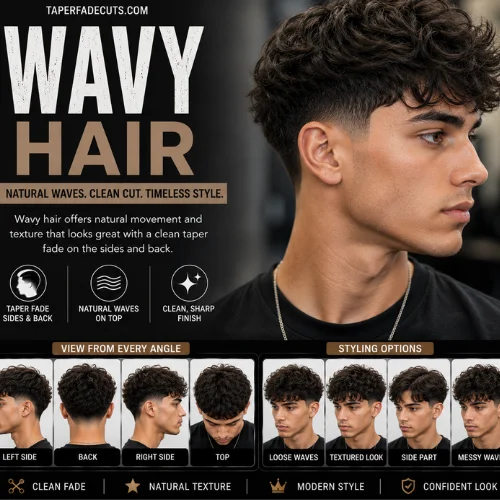
Type 2 hair ranges from loose waves to stronger S-shaped waves. Because it has less curl definition than type 3 or type 4 hair, keeping enough length on top is important if you want the natural texture to remain visible.
A low or mid taper fade usually works well with wavy hair because it cleans up the temples and neckline while preserving the movement and volume on top. A shorter top can make the waves less noticeable, while a medium-length top gives them more room to form naturally.
For styling, use a lightweight curl cream or styling product that enhances texture without making the hair heavy. Apply it to damp hair and let the waves air-dry or use a diffuser on low heat.
Best taper: Low or mid taper
Best top length: Short to medium
Best for: 2A, 2B, and 2C waves
Styling Tip:
Enhance your natural waves with a lightweight sea salt spray or curl cream for added texture. Keep the top at a medium length and trim the taper fade for curly hair every 2–3 weeks to maintain a clean, defined look.
Loose Curls (Type 3a and 3b)
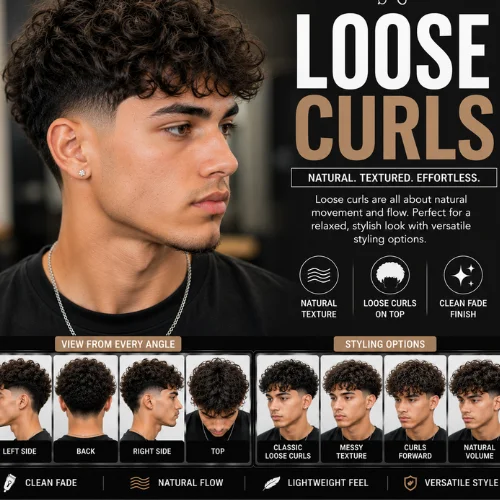
These curl types form defined, springy loops. They have more volume than waves but aren’t as dense as coil patterns.
Most taper fade styles work well here. The mid taper is especially flattering because it lets the curls sit at their natural height without flattening or stretching them. Avoid cutting too much length off the top, since these curls can shrink significantly when dry.
Tight Curls (Type 3c and 4a)
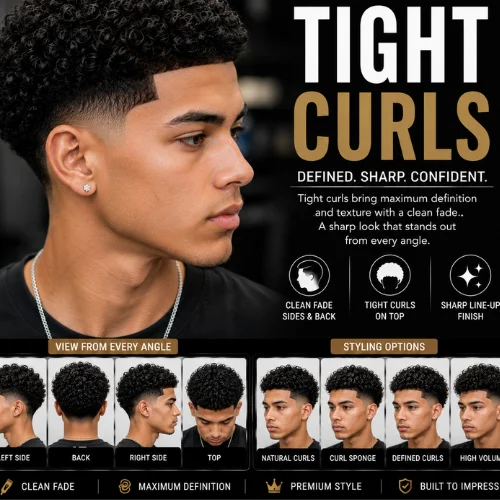
Type 3A and 3B hair forms visible, springy curls with more definition and volume than wavy hair. These curls can work with almost any taper height, but the amount of length left on top can make a significant difference to the finished look.
A mid taper fade is a versatile choice for 3A and 3B curls because it creates a balanced transition while leaving enough hair on top for the curls to maintain their natural shape. A low taper gives a softer appearance, while a high taper creates more contrast.
Curly hair can also appear shorter after it dries because of shrinkage. For this reason, your barber should consider the hair in its natural state before taking significant length off the top.
For styling, apply a lightweight curl cream or leave-in conditioner to damp hair and allow the curls to form naturally. Avoid excessive brushing after the hair has dried, as it can separate the curl pattern and increase frizz.
Best taper: Mid taper for versatility
Best top length: Medium
Best for: Defined, springy curls with natural volume
Coily and Kinky Hair (Type 4b and 4c)
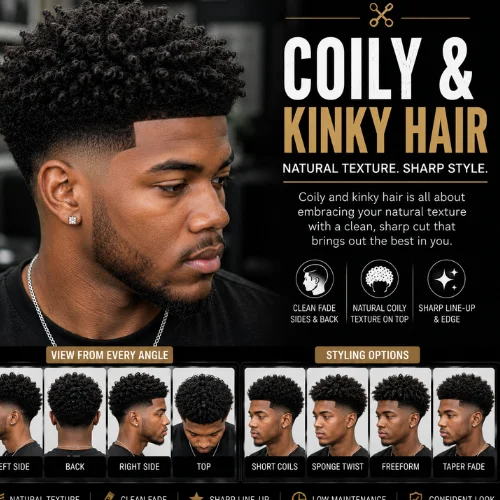
Type 4B and 4C hair has a tightly coiled texture with significant shrinkage and natural density. The visible length can be much shorter than the hair’s stretched length, so a barber should work with the hair’s natural shape when creating the taper and shaping the top.
A high taper can create a strong contrast between the shorter sides and the fuller texture on top, while a low taper keeps more fullness around the sides for a softer outline. An afro taper is another option if you want to maintain a rounded, natural shape on top.
For 4B and 4C hair, the shape of the top is just as important as the taper itself. Your barber should create an even silhouette without removing more length than necessary.
Moisture is also important for maintaining the natural texture. Use a suitable leave-in conditioner or moisturizing curl product, and avoid excessive brushing or manipulation that can disturb the coils.
Best taper: High taper for stronger contrast; low taper for more fullness
Best top style: Natural coils or afro shape
Best for: Dense 4B and 4C coily hair
Styling Tip: Keep the coils moisturized with a lightweight leave-in conditioner or curl cream, then gently define them with your fingers or a sponge. Avoid over-brushing, as this can cause frizz and disrupt the natural coil pattern.
How to Choose a Taper Fade for Your Face Shape
Your face shape can help you decide how high or low to take the taper, but your curl pattern, hair density, and personal preference matter too. The goal is to create a balanced overall shape rather than follow a strict rule.
Oval Face
An oval face is naturally balanced, so most taper heights can work well. A low or mid taper can keep the proportions natural, while a higher taper creates more contrast around the sides.
Good options: Low, mid, or high taper.
Round Face
If you have a rounder face, keeping some height and volume on top can create a more elongated appearance. A mid or high taper can reduce visual bulk around the sides while drawing attention upward toward the curls.
Good options: Mid or high taper with volume on top.
Square Face
A square face already has strong angles around the jaw and forehead. A low or mid taper can complement those proportions without making the sides look excessively narrow.
Good options: Low or mid taper.
Oblong or Long Face
With a longer face shape, keeping some fullness around the sides can help create a more balanced appearance. A low taper is often a good starting point, especially when paired with moderate volume on top.
Good options: Low taper with balanced top and side volume.
Heart-Shaped Face
A heart-shaped face is typically wider around the forehead and narrower toward the chin. Keeping some texture and volume through the sides can help balance the proportions.
Good options: Low or mid taper with a textured or curly top.
Diamond Face
A diamond-shaped face is wider around the cheekbones and narrower at the forehead and jaw. A low or mid taper can preserve enough fullness around the sides while keeping the temples and neckline clean.
Good options: Low or mid taper.
Quick Tip
Face shape should be a guide, not a strict rule. A skilled barber can adjust the taper height, top length, and shape of your curls to suit your individual features. If you are unsure, bring a reference photo and ask your barber which variation will work best with your natural hair.
How to Ask Your Barber for a Taper Fade For Curly Hair
A good curly taper fade depends on clear communication with your barber. Instead of simply asking for a “taper fade,” explain how high you want the taper, how much length you want to keep on top, and how you want your curls to look when finished.
1. Tell Your Barber the Taper Height
Start by choosing a low, mid, or high taper.
- Low taper: Keeps more hair around the sides and creates a subtle finish.
- Mid taper: Creates balanced contrast and works with many curl patterns.
- High taper: Creates stronger contrast and puts more emphasis on the curls on top.
If you are unsure, show your barber a reference photo and ask which taper height would work best with your hair.
2. Explain How Much Length You Want on Top
Tell your barber whether you want short, medium, or long curls on top. Remember that curly and coily hair can shrink when it dries, so the visible length may be shorter than the length measured while the hair is stretched.
If maintaining volume is important to you, make that clear before the haircut begins.
3. Show a Reference Photo
A clear reference photo can prevent misunderstandings. Ideally, choose a photo of someone with a similar curl pattern, hair density, and approximate hair length.
You can also show separate photos for the taper and the top if you want to combine features from different hairstyles.
4. Explain How You Want Your Curls Styled
Tell your barber whether you want your curls:
- Natural and loose
- Defined and separated
- Short and controlled
- Full and voluminous
- Forward as a fringe
- Shaped into an afro or longer style
This helps the barber decide how much length and weight to leave on top.
5. Ask About the Hairline and Neckline
Ask whether your natural hairline should be kept or slightly cleaned up. A sharp line up can create a more structured appearance, while a natural hairline gives the haircut a softer look.
The same applies to the neckline. Your barber can help choose a finish that matches the shape of your taper.
6. Ask How Your Hair Should Be Cut
Curly hair can look different when it is wet, stretched, or completely dry. Ask your barber how they prefer to work with your particular curl pattern and how they account for shrinkage.
There is no single cutting method that is best for every curly hair type. Experience with your specific texture is more important than following one universal technique.
Simple Barber Request
If you want a simple way to explain the haircut, you can say:
“I want a [low/mid/high] taper, keep [short/medium/long] length on top, and keep my natural curls [defined/natural/voluminous]. Please keep the taper clean around the temples and neckline without taking too much length from the top.”
That gives your barber the three most important details: taper height, top length, and desired curl finish.
How a Taper Fade for Curly Hair Is Cut
A professional curly taper fade is usually created by gradually reducing the length around the temples, sides, and neckline while preserving the desired length and shape on top. The exact technique varies depending on the curl pattern, hair density, and taper height.
1. Assess the Curl Pattern
The barber first looks at the natural curl or coil pattern, density, growth direction, and current length. This helps determine how much hair can be removed without changing the desired shape.
2. Establish the Taper Area
The barber identifies where the taper will begin based on whether you want a low, mid, or high taper. The transition should follow the natural shape of the head rather than creating an uneven or overly harsh line.
3. Gradually Blend the Sides
Different clipper guards and blending techniques are used to reduce the hair progressively. The goal is a smooth transition from the longer hair into the shorter area around the temples and neckline.
4. Shape the Curly Top
The top is trimmed according to the desired style. Depending on the haircut, the curls may be left natural, shaped into an afro, directed forward as a fringe, or kept longer for additional volume.
5. Clean the Edges
The barber then cleans the hairline, temples, and neckline. You can request a natural finish or a sharper line up depending on your preference.
6. Check the Finished Shape
Curly hair can change appearance as it dries and settles. The barber should check the haircut from multiple angles to make sure the taper and top create a balanced shape.
Can You Do a Curly Taper Fade at Home?
A basic taper may be possible with the right clippers and experience, but creating a smooth fade around the temples and neckline is difficult to do on yourself. Curly and coily hair can also make uneven blending more noticeable.
For the cleanest result, especially when trying a new taper height, a professional barber with experience cutting curly hair is the better option.
How to Maintain a Taper Fade with Curly Hair
Maintaining a curly taper fade involves two things: keeping the tapered areas clean and keeping the curls on top moisturized and well-shaped. The fade usually needs attention more often than the longer hair on top.
Keep the Taper Fresh
Most people can maintain a clean-looking taper with a barber visit about every 2–4 weeks, depending on how quickly their hair grows and how sharp they want the fade to look.
If you prefer a very crisp neckline and temples, you may want more frequent touch-ups. A more natural taper can usually grow out for longer without looking noticeably untidy.
Wash and Condition Your Curls
Curly hair can become dry more easily than straight hair, so avoid washing it more often than necessary. Choose a gentle shampoo and follow it with a moisturizing conditioner.
How often you wash depends on your scalp, hair type, activity level, and styling routine. There is no single schedule that works for everyone.
Moisturize After Washing
Apply a suitable leave-in conditioner or curl cream while your hair is damp. This can help the curls stay soft, defined, and easier to manage.
Use only enough product to coat the hair without making the curls heavy or greasy.
Dry Your Hair Gently
Avoid aggressively rubbing curly hair with a regular towel because friction can increase frizz and disturb the curl pattern. Instead, gently squeeze out excess water with a microfiber towel or soft cotton T-shirt.
You can air-dry your curls or use a diffuser on a low-heat setting if you want to speed up drying while maintaining their shape.
Protect Your Curls While Sleeping
A satin or silk pillowcase can reduce friction between your hair and the pillow. Some people also use a satin bonnet or loosely gather longer curls before sleeping.
The goal is to reduce unnecessary friction and preserve the curl pattern overnight.
Avoid Over-Manipulating Curly Hair
Repeated brushing, combing, or touching after the curls have dried can separate the curl pattern and create extra frizz. Once your curls are shaped, let them settle naturally.
Know When Your Hair Needs a Trim
Your taper may need a touch-up when the temples and neckline start losing their clean shape. The curls on top may not need trimming at the same time.
If the top still looks healthy and has the shape you want, you can ask your barber to refresh only the taper and edges.
Best Products for Curly Hair Taper Fades
The best products for a curly taper fade should help maintain moisture, definition, and manageability without making the curls heavy. The right choice depends on your curl pattern, hair density, and how much hold you want.
Curl Defining Cream
A curl defining cream can add moisture while helping curls maintain their natural shape. Apply a small amount to damp hair and distribute it evenly through the curls.
This is a good everyday option when you want definition without a stiff or crunchy finish.
Leave-In Conditioner
A lightweight leave-in conditioner can help keep curly and coily hair feeling moisturized between washes. It can be especially useful if your hair tends to feel dry or becomes difficult to manage.
Apply a small amount to damp hair and focus on the longer curls rather than the tapered sides.
Lightweight Styling Gel
If you want stronger curl definition or longer-lasting hold, a lightweight styling gel can be layered over a curl cream or leave-in conditioner.
Start with a small amount and increase gradually. Too much product can weigh down the curls or leave unwanted buildup.
Lightweight Hair Oil
A small amount of lightweight oil can be used as a finishing product to add shine and help reduce the feeling of dryness. Argan or jojoba oil are common options, but the best choice depends on how your hair responds to oils.
Use only a few drops, especially if your hair is fine or easily weighed down.
Clarifying Shampoo
If you regularly use creams, gels, oils, or other styling products, occasional clarifying can help remove buildup. How often you need it depends on your products and washing routine.
Avoid using a strong clarifying shampoo too frequently if it leaves your curls feeling dry.
How to Choose Products for Your Curl Type
- Wavy hair: Choose lightweight products that enhance texture without adding too much weight.
- Loose curls: Look for products that provide moisture and moderate definition.
- Tight curls: Choose moisturizing products that help maintain definition without excessive buildup.
- Coily hair: Prioritize moisture and manageability, especially when the hair is longer or very dense.
You do not need a large collection of products. Start with one moisturizing product and one styling product, then adjust your routine based on how your curls respond.
Trending Taper Fade Curly Hair Styles Right Now
Curly taper fade trends in 2026 are moving toward natural texture, cleaner outlines, and hairstyles that work with the hair’s original curl pattern rather than trying to make every curl look identical. The most popular looks can vary by region and personal style, but several themes are becoming especially common.
Natural Texture and Defined Curls
More curly taper fades are keeping the natural curl pattern visible instead of heavily manipulating the top. Lightweight styling products can enhance definition while preserving movement and volume.
Curly Fringe
Curly fringe styles continue to offer an easy way to add texture around the forehead. The fringe can be short and controlled or longer and more relaxed depending on the curl pattern.
Curly Taper Fade with a Line Up
A clean line up creates a sharp contrast against naturally textured curls. It is particularly effective when the taper, temples, and forehead are kept crisp.
Curly Taper Fade Mullet
The curly taper fade mullet combines shorter tapered sides with longer textured hair toward the back. It is a more distinctive option for people who want additional length and movement.
Low-Maintenance Curly Tapers
Another major trend is keeping the styling routine simple. Instead of heavily styling the top every day, many curly-haired men are choosing a clean taper with naturally shaped curls and minimal product.
How to Choose a Trend That Will Last
Trends can change quickly, so choose a style based on your curl pattern, face shape, hair density, and preferred maintenance level. A haircut that works with your natural texture will usually be easier to maintain than a style that requires constant reshaping or heavy styling.
Frequently Asked Questions
Does a taper fade work with curly hair?
Yes. A taper fade works well with curly hair because it cleans up the temples, sides, and neckline while allowing the natural texture and volume on top to remain visible. The best taper height depends on your curl pattern, hair density, and preferred look.
What is the best taper fade for curly hair?
There is no single best taper for everyone. A low taper is a good choice for a subtle, natural finish, while a mid taper offers balanced contrast. A high taper creates stronger contrast and can work well with dense curls and coils.
Is a low or mid taper better for curly hair?
Both can work well. A low taper preserves more fullness around the sides and creates a softer appearance, while a mid taper removes more bulk and provides a more noticeable transition. Your curl pattern and desired style should guide the choice.
How often should you get a curly taper fade?
Most people can refresh a curly taper about every 2–4 weeks, depending on how quickly their hair grows and how sharp they want the taper to look. The curls on top may not need trimming every time the taper is refreshed.
How long should curly hair be on top for a taper fade?
The ideal length depends on your curl pattern and the style you want. Short curls can create a clean, low-maintenance look, while medium or longer curls provide more volume and styling options. Because curly hair shrinks as it dries, discuss the desired finished length with your barber.
Can you get a taper fade with 4C hair?
Yes. A taper can work very well with 4C hair. A low taper can preserve more fullness around the sides, while a high taper creates stronger contrast with the natural coils on top. An experienced barber should account for shrinkage and the natural shape of the hair.
Should curly hair be cut wet or dry for a taper?
There is no universal rule that applies to every curl pattern. Curly hair can change significantly in appearance when wet, stretched, and dry, so the cutting approach should account for its natural shape and shrinkage. Ask your barber which method they use for your specific texture.
Can you do a curly taper fade at home?
A basic taper may be possible with the right tools and experience, but creating a smooth blend around the temples and neckline can be difficult to do yourself. For a clean result, especially when trying a new taper height, a professional barber is usually the better option.
Conclusion
A taper fade for curly hair gives you a clean, structured haircut while allowing your natural curls or coils to remain the focus. The right choice depends on your curl pattern, face shape, hair density, and how much maintenance you want.
A low taper keeps the look subtle, a mid taper offers balanced contrast, and a high taper creates a sharper transition around the sides. You can also combine a curly taper with a fringe, afro, line up, longer top, or mullet depending on your preferred style.
For the best result, choose a barber who has experience with your hair texture, bring a reference photo, and explain how much length you want to keep on top. Regular taper touch-ups and a simple moisture-focused curl routine will help keep the haircut looking fresh.


Thank you for your comment! You’re absolutely right—a taper fade is one of the most versatile haircuts. It works well with different hair lengths, textures, and face shapes, making it a popular choice for many people. We appreciate your feedback and hope you enjoy more haircut guides on our website!
> Thank you for your comment! We completely agree—curly hair and a high taper fade are a great combination. The clean taper on the sides helps the curls stand out, and using a quality curl cream or styling gel can keep them defined and healthy-looking. We appreciate you sharing your thoughts!